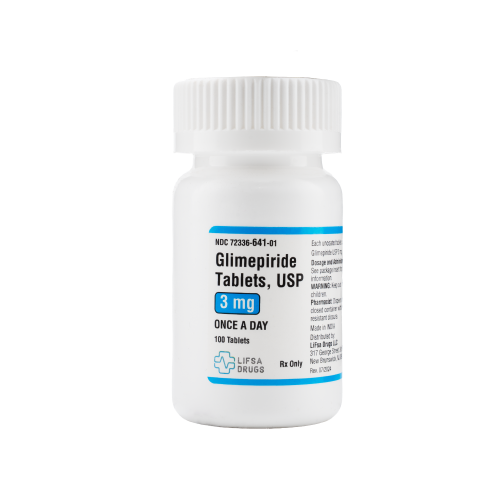



Glimepiride tablets, USP are an oral sulfonylurea that contains the active ingredient glimepiride. Chemically, glimepiride is identified as 1-[[p-[2-(3-ethyl-4-methyl-2-oxo-3-pyrroline-1-carboxamido) ethyl]phenyl]sulfonyl]-3-(trans-4-methylcyclohexyl) urea (C24H34N4O5S) with a molecular weight of 490.62. Glimepiride USP is a white to almost white, crystalline, odorless to practically odorless powder and is practically insoluble in water.
Glimepiride tablets, USP contain the active ingredient glimepiride and the following inactive ingredients: lactose monohydrate, magnesium stearate, microcrystalline cellulose, povidone, sodium lauryl sulfate and sodium starch glycolate. In addition, Glimepiride 3 mg tablets contain Ferric Oxide Yellow.
Glimepiride tablets are indicated as an adjunct to diet and exercise to improve glycemic control in adults with type 2 diabetes mellitus.
Limitations of Use
Glimepiride tablets should not be used for the treatment of type 1 diabetes mellitus or diabetic ketoacidosis, as it would not be effective in these settings.
Glimepiride tablets should be administered with breakfast or the first main meal of the day.
The recommended starting dose of glimepiride tablets is 1 mg or 2 mg once daily. Patients at increased risk for hypoglycemia (e.g., the elderly or patients with renal impairment) should be started on 1 mg once daily.
After reaching a daily dose of 2 mg, further dose increases can be made in increments of 1 mg or 2 mg based upon the patient’s glycemic response. Uptitration should not occur more frequently than every 1 to 2 weeks. A conservative titration scheme is recommended for patients at increased risk for hypoglycemia.
The maximum recommended dose is 8 mg once daily.
Patients being transferred to glimepiride tablets from longer half-life sulfonylureas (e.g., chlorpropamide) may have overlapping drug effect for 1 to 2 weeks and should be appropriately monitored for hypoglycemia.
When colesevelam is coadministered with glimepiride, maximum plasma concentration and total exposure to glimepiride is reduced. Therefore, glimepiride tablets should be administered at least 4 hours prior to colesevelam.
Glimepiride tablets are contraindicated in patients with a history of a hypersensitivity reaction to:
• Glimepiride or any of the product’s ingredients.
• Sulfonamide derivatives: Patients who have developed an allergic reaction to sulfonamide derivatives may develop an allergic reaction to glimepiride tablets. Do not use glimepiride tablets in patients who have a history of an allergic reaction to sulfonamide derivatives.
Full Prescribing Information: DailyMed