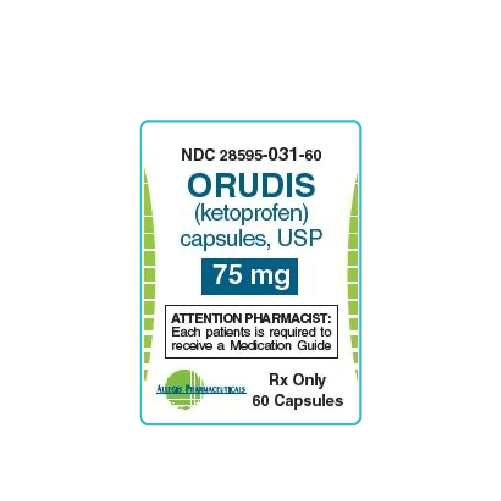



Carefully consider the potential benefits and risks of ORUDIS and other treatment options before deciding to use ORUDIS. Use the lowest effective dose for the shortest duration consistent with individual patient treatment goals (see WARNINGS).
After observing the response to initial therapy with ORUDIS, the dose and frequency should be adjusted to suit an individual patient's needs.
Concomitant use of ORUDIS and ketoprofen extended-release capsules is not recommended.
If minor side effects appear, they may disappear at a lower dose which may still have an adequate therapeutic effect. If well tolerated but not optimally effective, the dosage may be increased.
Individual patients may show a better response to 300 mg of ORUDIS daily as compared to 200 mg, although in well-controlled clinical trials patients on 300 mg did not show greater mean effectiveness. They did, however, show an increased frequency of upper- and lower-GI distress and headaches. It is of interest that women also had an increased frequency of these adverse effects compared to men. When treating patients with 300 mg/day, the physician should observe sufficient increased clinical benefit to offset potential increased risk.
In patients with mildly impaired renal function, the maximum recommended total daily dose of ketoprofen ORUDIS is 150 mg. In patients with a more severe renal impairment (GFR less than 25 mL/min/1.73 m2 or end-stage renal impairment), the maximum total daily dose of ORUDIS should not exceed 100 mg.
In elderly patients, renal function may be reduced with apparently normal serum creatinine and/or BUN levels. Therefore, it is recommended that the initial dosage of ORUDIS should be reduced for patients over 75 years of age (see Geriatric Use).
It is recommended that for patients with impaired liver function and serum albumin concentration less than 3.5 g/dL, the maximum initial total daily dose of ORUDIS should be 100 mg. All patients with metabolic impairment, particularly those with both hypoalbuminemia and reduced renal function, may have increased levels of free (biologically active) ketoprofen and should be closely monitored. The dosage may be increased to the range recommended for the general population, if necessary, only after good individual tolerance has been ascertained.
Because hypoalbuminemia and reduced renal function both increase the fraction of free drug (biologically active form), patients who have both conditions may be at greater risk of adverse effects. Therefore, it is recommended that such patients also be started on lower doses of ORUDIS and closely monitored.
Rheumatoid Arthritis and Osteoarthritis
The recommended starting dose of ORUDIS in otherwise healthy patients is 75 mg three times or 50 mg four times a day. Smaller doses of ORUDIS should be utilized initially in small individuals or in debilitated or elderly patients. The recommended maximum daily dose of ORUDIS is 300 mg/day.
Dosages higher than 300 mg/day of ORUDIS are not recommended because they have not been studied. Concomitant use of ORUDIS and ketoprofen extended-release capsules is not recommended. Relatively smaller people may need smaller doses.
As with other non-steroidal anti-inflammatory drugs, the predominant adverse effects of ketoprofen are gastrointestinal. To attempt to minimize these effects, physicians may wish to prescribe that ORUDIS be taken with antacids, food, or milk. Although food delays the absorption of ORUDIS (see CLINICAL PHARMACOLOGY), in most of the clinical trials ketoprofen was taken with food or milk.
Physicians may want to make specific recommendations to patients about when they should take ORUDIS in relation to food and/or what patients should do if they experience minor GI symptoms associated with ORUDIS.
Management of Pain and Dysmenorrhea
The usual dose of ORUDIS recommended for mild-to-moderate pain and dysmenorrhea is 25 to 50 mg every 6 to 8 hours as necessary. A smaller dose should be utilized initially in small individuals, in debilitated or elderly patients, or in patients with renal or liver disease (see PRECAUTIONS). A larger dose may be tried if the patient’s response to a previous dose was less than satisfactory, but doses above 75 mg have not been shown to give added analgesia. Daily doses above 300 mg are not recommended because they have not been adequately studied. Because of its typical non-steroidal anti-inflammatory drug-side-effect profile, including as its principal adverse effect GI side effects (see WARNINGSand ADVERSE REACTIONS), higher doses of ORUDIS should be used with caution and patients receiving them observed carefully.
ORUDIS is contraindicated in patients who have shown hypersensitivity to ketoprofen.
ORUDIS should not be given to patients who have experienced asthma, urticaria, or allergic-type reactions after taking aspirin or other NSAIDs. Severe, rarely fatal, anaphylactic reactions to ketoprofen have been reported in such patients (see WARNINGS, Anaphylacroid Reactions and PRECAUTIONS, Preexisting Asthma).
ORUDIS is contraindicated in the setting of coronary artery bypass graft (CABG) surgery (see WARNINGS).
Full Prescribing Information: DailyMed