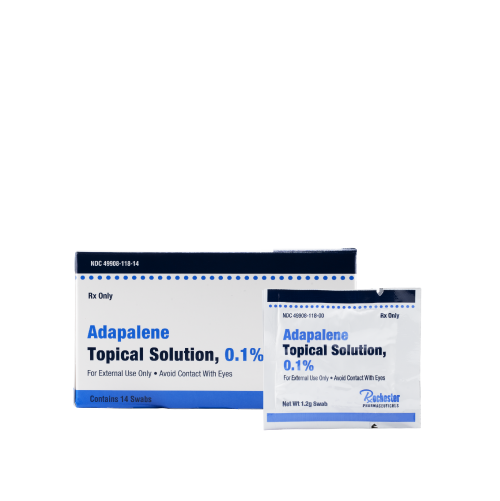
Click to enlarge



During the early weeks of therapy, an apparent exacerbation of acne may occur. This is due to the action of the medication on previously unseen lesions and should not be considered a reason to discontinue therapy. Therapeutic results should be noticed after eight to twelve weeks of treatment.
Adapalene Topical Solution, 0.1% should not be administered to individuals who are hypersensitive to adapalene or any of the components in the vehicle solution.
Use of Adapalene Topical Solution, 0.1% should be discontinued if hypersensitivity to any of the ingredients is noted. Patients with sunburn should be advised not to use the product until fully recovered.
If a reaction suggesting sensitivity or chemical irritation occurs, use of the medication should be discontinued. Exposure to sunlight, including sunlamps, should be minimized during the use of adapalene. Patients who normally experience high levels of sun exposure, and those with inherent sensitivity to sun, should be warned to exercise caution. Use of sunscreen products and protective clothing over treated areas is recommended when exposure cannot be avoided. Weather extremes, such as wind or cold, also may be irritating to patients under treatment with adapalene.
Avoid contact with the eyes, lips, angles of the nose, and mucous membranes. The product should not be applied to cuts, abrasions, eczematous skin, or sunburned skin.
Certain cutaneous signs and symptoms such as erythema, dryness, scaling, burning, or pruritus may be experienced during treatment. These are most likely to occur during the first two to four weeks and will usually lessen with continued use of the medication. Depending upon the severity of adverse events, patients should be instructed to reduce the frequency of application or discontinue use.
As Adapalene Topical Solution, 0.1% has the potential to produce local irritation in some patients, concomitant use of other potentially irritating topical products (medicated or abrasive soaps and cleansers, soaps and cosmetics that have a strong drying effect, and products with high concentrations of alcohols, astringents, spices or lime) should be approached with caution. Particular caution should be exercised in using preparations containing sulfur, resorcinol, or salicylic acid in combination with Adapalene Topical Solution, 0.1%. If these preparations have been used, it is advisable not to start therapy with Adapalene Topical Solution, 0.1% until the effects of such preparations in the skin have subsided.
Carcinogenicity studies with adapalene have been conducted in mice at topical doses of 0.3, 0.9, and 2.6 mg/kg/day and in rats at oral doses of 0.15, 0.5, and 1.5 mg/kg/day, approximately 4-75 times the maximal daily human topical dose. In the oral study, positive linear trends were observed in the incidence of follicular cell adenomas and carcinomas in the thyroid glands of female rats, and in the incidence of benign and malignant pheochromocytomas in the adrenal medullas of male rats.
No photocarcinogenicity studies were conducted. Animal studies have shown an increased tumorigenic risk with the use of pharmacologically similar drugs (e.g., retinoids) when exposed to UV irradiation in the laboratory or to sunlight. Although the significance of these studies to humans is not clear, patients should be advised to avoid or minimize exposure to either sunlight or artificial UV irradiation sources.
In a series of in vivo and in vitro studies, adapalene did not exhibit mutagenic or genotoxic activities.
Teratogenic effects
Pregnancy Category C
No teratogenic effects were seen in rats at oral doses of adapalene 0.15 to 5.0 mg/kg/day, up to 120 times the maximal daily human topical dose. Cutaneous route teratology studies conducted in rats and rabbits at doses of 0.6, 2.0, and 6.0 mg/kg/day, up to 150 times the maximal daily human topical dose exhibited no fetotoxicity and only minimal increases in supernumerary ribs in rats. There are no adequate well-controlled studies in pregnant women. Adapalene should be used during pregnancy only if the potential benefit justifies the potential risk to the fetus.
It is not known whether this drug is excreted in human milk. Because many drugs are excreted in human milk, caution should be exercised when Adapalene Topical Solution, 0.1% is administered to a nursing woman.
Safety and effectiveness in pediatric patients below the age of 12 have not been established.
Some adverse effects such as erythema, scaling, dryness, pruritus, and burning will occur in 30-60% of patients. Pruritus or burning immediately after application also occurs in approximately 30% of patients. The following additional adverse experiences were reported in approximately 1% or less of patients: skin irritation, burning/stinging, erythema, sunburn, and acne flares. These are most commonly seen during the first month of therapy and decrease in frequency and severity thereafter. All adverse effects with the use of adapalene solution during clinical trials were reversible upon discontinuation of therapy.
To report SUSPECTED ADVERSE REACTIONS, contact Rochester Pharmaceuticals at 1 -866-458-1772 or FDA at 1-800-FDA-1088 or www.fda.gov/medwatch.
Full Prescribing Information: DailyMed